

In short. The wattage printed on the housing is not the real diode laser power. In most cases it is a peak figure, and the machine gives noticeably less during a normal treatment day. Actual diode laser power depends on three things at once: peak versus average mode, how many diode bars the stack has and, above everything, the power supply. You confirm it with a measuring instrument, never with a label.
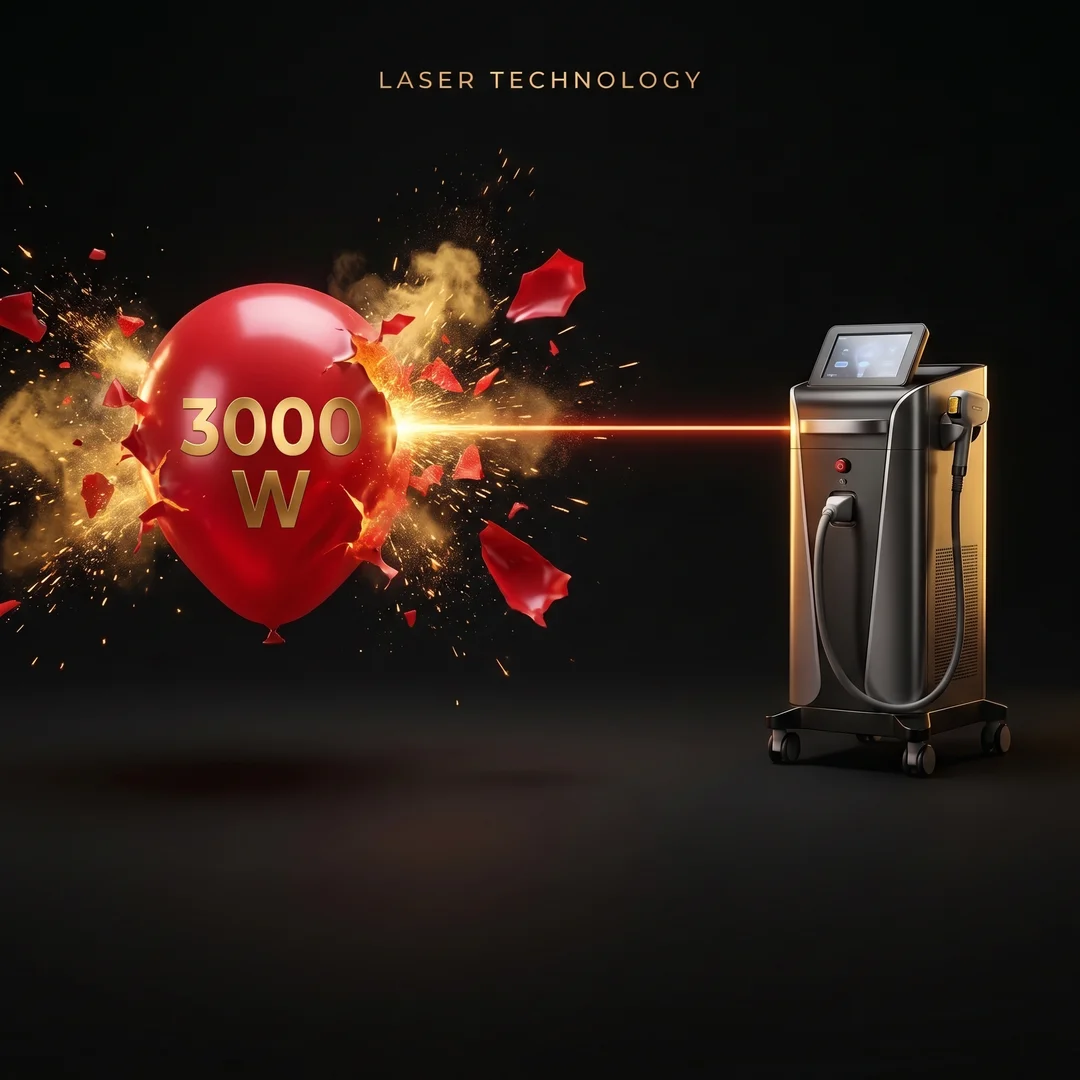
“3000 W” is peak power, not real work
Sellers inflate the number in two ways. The first: they quote the power of a short pulse, while in continuous work the machine is noticeably weaker. The second, even more common: they quote the electrical power the machine draws from the outlet, not the light that reaches the skin, because part of that energy goes to cooling, pumps and the screen. So a machine rated, say, 1600 W on paper can have real optical power several times lower.
The takeaway is simple: “3000 W” on the housing and the real working diode laser power on the skin are two different numbers. So ask directly: is this power drawn from the outlet or optical output, and is it peak or continuous power?
Why a machine cannot run at its peak all day
Heat is what limits a diode. Push the power up and the crystal temperature rises; past a certain limit the damage to the crystal cannot be undone. Diode stack makers therefore cap both power and duty cycle on purpose. A high peak only exists in short bursts, so a machine simply cannot work at that number hour after hour. By physics, the peak cannot be your working power.
The power supply decides how much diode laser power you really get
Ads never mention this, and plenty of people who sell these machines do not know it either. The bars inside a stack are wired in series, and how much light a diode puts out depends on the pump current flowing through it, not on the label. A bigger stack only makes sense with a bigger power supply that can push more current.
In other words, the limit is the power supply, not the stack: no machine can output more than its supply is physically able to feed it. What you actually get is the stack, the driver and the power supply working together, and a single sticker cannot tell you that.
Three questions to ask about any wattage
- Peak or average? These two numbers can differ several times.
- How many bars does the stack have? Multiply the bar count by the power of one bar to get the total.
- Which operating mode, and what driver current?
Two machines with the same “2000 W” on the box can be completely different inside.
How to check real diode laser power
- Measure. Output is checked with a laser power or energy meter; an integrating sphere captures all of the optical power whatever the beam shape. Real power slowly goes down with use and is rarely exactly what the datasheet says, so a periodic check with an instrument makes sense.
- Request the spec sheet: bar count, continuous or pulsed operation, driver current and the rating of the power supply.
- Compare the numbers: can this power supply actually feed the stack power the seller claims?
Watts vs fluence: do not confuse them
People mix these two up all the time, but they measure different things.
- Fluence (J/cm²) is the energy delivered to each square centimeter of skin, and it is what kills the follicle. Typical working settings are about 20-40 J/cm², chosen by the operator for the skin and hair type.
- Power (W) does not decide whether the treatment works. It decides productivity: the spot size the machine can hold and the speed of the session.
Put simply: fluence decides whether the hair is destroyed, power decides how fast you cover the whole area. The same fluence can be reached on a weaker and on a more powerful machine; the more powerful one just does it with a bigger spot and faster. More on choosing a machine in our guide how to choose the best laser hair removal device.
Where Lasertechnology stands
In our diode laser hair removal machines the stated power is real. Our engineers set the build specification: a specific stack with a power supply and components matched to it. So when we write 2000 W, that is a real 2000 W stack, and 1200 W means a real 1200 W. You can test the machine before you buy.
Lasertechnology machines with real diode laser power
- SilkPulse 1800 – our flagship, 808 nm, 1800 W, freon chiller for 24/7 work. $15,290.
- Hunter 2000 – 808 nm, 2000 W, for med spas with a high client flow. $17,500.
- Smart Baby LE – portable, 808 nm, 800 W. $11,899.
- See all diode laser hair removal machines
Check the real diode laser power before you buy
Do not trust the sticker, and do not take our word for it. Leave your details and book a test: we will show you the stack configuration and the power supply of the machine you are considering, and match a machine to your client flow.
Frequently Asked Questions
What is the real diode laser power, and how many watts does a machine really have?
Why does the housing say 3000 W?
How do I check diode laser power before buying?
What matters more, watts or fluence?
Read also
- Beyond the Hype: How to Choose the Best Laser Hair Removal Device
- Diode Lasers with Multiple Wavelengths: Marketing Gimmick or Real Effectiveness?
- Diode Laser Cooling for Hair Removal: Why Ice or Frost on the Handpiece Is Bad
Updated October 12, 2026