

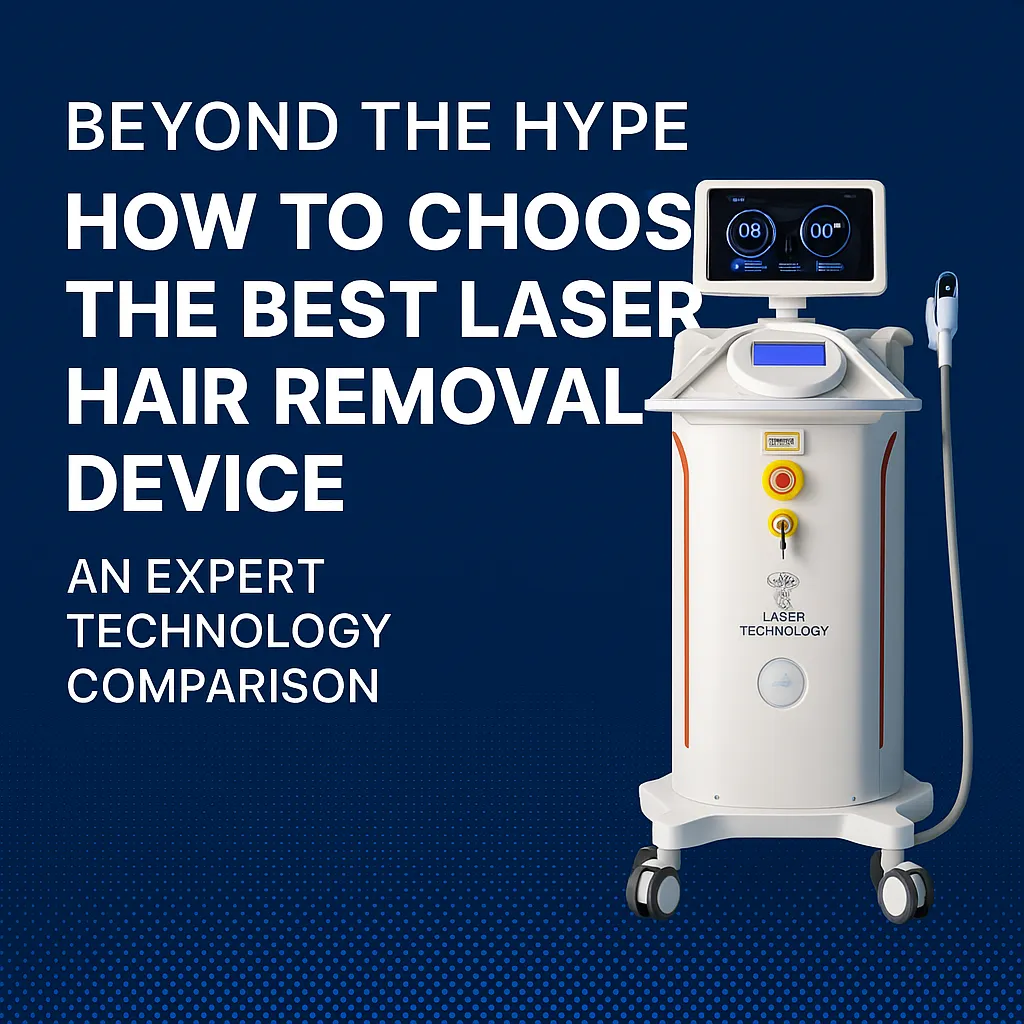
The best professional laser hair removal machine for most clinics is an 808nm diode laser: it treats Fitzpatrick skin types I to V, balances speed and safety, and has the lowest cost per session. Nd:YAG (1064nm) is safer for very dark skin; alexandrite (755nm) suits fair skin but costs more to run.
Introduction:
The laser hair removal market is saturated with options. Every manufacturer claims their technology is superior, but how can you see past the marketing slogans to find real effectiveness and safety in laser hair removal? How do you choose the best laser hair removal device that won’t just remove hair, but do it predictably, safely across different skin types (Fitzpatrick scale), and offer a strong return on investment (ROI) for your aesthetics business or comfortable personal use?
As specialists whose journey began with repairing and servicing laser hair removal systems, we at Lasertechnology have gained unique insights. We’ve seen what breaks, what underperforms, and why expensive professional laser hair removal machines don’t always live up to their price tags. Today, we’ll share this experience and knowledge to help you understand the physics of laser interaction and make an informed choice when buying laser hair removal equipment.
How Laser Hair Removal Works: The Science Explained
Effective laser hair removal relies on the principle of selective photothermolysis. Simply put, a laser generates light at a specific wavelength selectively absorbed by the melanin (pigment) in the hair follicle.
This absorbed light energy heats and damages the cells responsible for hair growth, aiming for permanent hair reduction without harming surrounding skin.
Key Laser Parameters for Effective & Safe Hair Removal
Understanding these is crucial for selecting a professional laser hair removal device:
- Wavelength (nm): Determines penetration depth and effectiveness for different skin tones and hair colors.
- Shorter (Ruby 694nm): High melanin absorption, risky for darker skin.
- Medium (Alexandrite 755nm, Diode 808nm): Good balance, versatile.
- Longer (Nd:YAG 1064nm): Safest laser for dark skin, penetrates deep.
- Pulse Duration (ms): Critical for laser hair removal safety. Heats the follicle without overheating the skin.
- Fluence (J/cm²): Energy needed to disable the follicle.
- Spot Size (mm): Affects laser treatment speed.
- Cooling System: Protects skin, enhances comfort. Quality skin cooling indicates a good laser hair removal machine.
Laser Hair Removal Technology Comparison: Pros & Cons
Let’s examine common laser types for hair removal from an engineer’s view:
| Technology | Skin types (Fitzpatrick) | Pros | Cons | Cost / ROI |
|---|---|---|---|---|
| Ruby 694nm | Very fair only (I-II) | Strong melanin absorption | Outdated, slow, risky on darker skin | Low relevance today |
| Alexandrite 755nm | Fair (I-III) | Effective on fair skin with dark hair | Riskier on tanned/dark skin, costly service (Candela) | High cost, slow payback |
| Diode 808nm | Most types (I-V) | Best balance, versatile, flexible settings, safe | Result depends on machine quality and operator skill | Best ROI (lower machine and service cost) |
| Nd:YAG 1064nm | Dark/tanned (V-VI) | Safest for very dark skin | Less comfortable, more sessions on light hair | Niche |
| IPL (not a laser) | Limited | Cheap up front | Broad-spectrum, unfocused, weaker, not for dark skin | Low effectiveness |
- Ruby Laser (694 nm):
- Cons: Outdated, only for very fair skin, slow.
- Alexandrite Laser (755 nm):
- Pros: Effective for Fitzpatrick I-III.
- Cons: Riskier for tanned/darker skin, high laser machine cost and maintenance (e.g., Candela), impacting business ROI.
- Diode Laser (800-810 nm): The Best Choice?
- Pros: Optimal balance, versatile for most skin types (I-V), flexible settings. Key Advantage: Best ROI due to lower diode laser cost and service expenses. Makes it ideal when looking to buy a laser hair removal machine for a salon or clinic.
- Cons: Diode laser effectiveness depends on machine quality and operator skill.
- Nd:YAG Laser (1064 nm):
- Pros: Safest laser for dark skin types (V-VI) and tanned skin.
- Cons: Can be less comfortable, may need more sessions for lighter hair.
- Important: IPL (Intense Pulsed Light) is NOT Laser Hair Removal!
- IPL uses broad-spectrum light, not a focused laser beam. Less effective for permanent hair removal, higher side effect risk, unsuitable for dark skin. IPL vs laser comparison clearly favors laser for hair removal efficacy.
So, Which is the Best Laser for Hair Removal?
Choosing the ideal laser hair removal equipment depends on your needs:
- For versatile clinics/medspas: A Diode laser is the most balanced, safe, and cost-effective laser solution, offering fast ROI.
- For treating predominantly dark skin: Nd:YAG laser.
- For fair skin/dark hair only: Alexandrite, but consider the high alexandrite laser cost.
Laser Hair Removal vs. Other Methods (Waxing, Sugaring, Electrolysis)
Laser isn’t the only option. Waxing, sugaring, and electrolysis hair removal (considered the only truly permanent hair removal method for all hair colors) exist. Each has pros and cons. We’ll compare laser hair removal vs electrolysis and other methods in a future blog post. Stay tuned!
Conclusion: Choose Your Laser Wisely
Selecting a laser hair removal device is an investment in quality, treatment safety, and results. Look beyond marketing. Study laser technical specifications, understand the science, and verify supplier reliability and laser equipment service & repair options. As experts who evolved from laser repair technicians to designers, Lasertechnology focuses on reliable and effective diode lasers, offering professional aesthetic equipment we trust. Need help choosing a diode laser or expert consultation? Contact us, we’re ready to share our laser technology knowledge.
References & Further Reading
- U.S. Food and Drug Administration. FDA consumer guidance on hair removal electrolysis and lasers.
- American Academy of Dermatology. AAD overview of laser hair removal (independent clinical reference).
Why Lasertechnology Picks 808nm as the Best Laser Hair Removal Device
- PRO MAX2000. flagship 808nm, 2000W, freon cooling.
- Hunter 2000. crystal-free 808nm, +40% energy efficiency.
- Optimus 1000. proven 808nm Coherent stack, triple cooling.
- All 808nm diode laser hair removal machines →
Frequently Asked Questions
Which laser is best for hair removal: diode, alexandrite or Nd:YAG?
Is an 808nm diode laser suitable for all skin types?
Why does a diode laser have better ROI than an alexandrite laser?
Is IPL the same as laser hair removal?
How much does a professional diode laser hair removal machine cost?
Not sure which laser fits your clinic?
Tell us your room, client load and skin types, and our engineers will recommend the right diode laser, with US service, warranty and interest-free payment plans.