

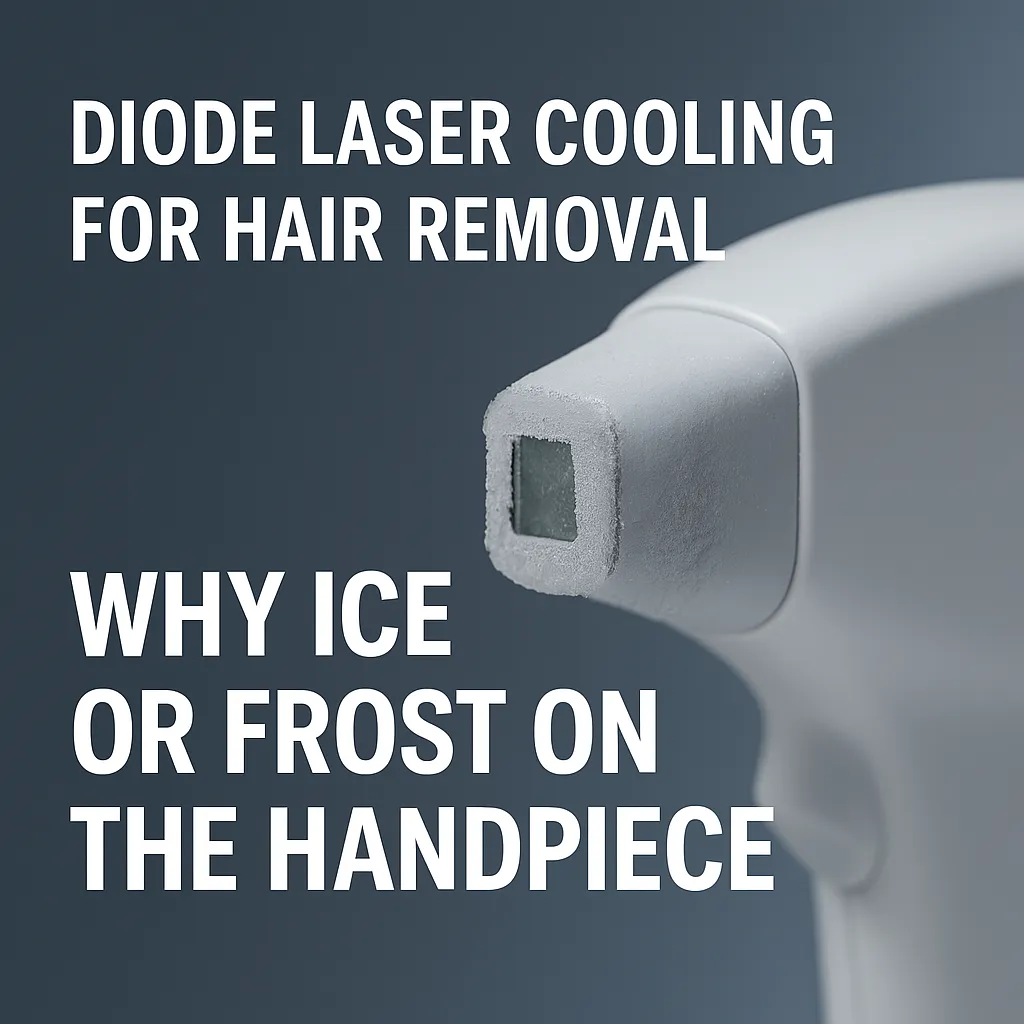
Diode laser cooling is the make-or-break feature of any 808nm diode laser hair removal machine. Get it right and clients walk out comfortable; get it wrong and you see frost on the handpiece, ruined sessions, and equipment failures. This guide breaks down exactly how proper diode laser cooling works, why frost is a red flag, and how Lasertechnology engineers our 808nm lineup to avoid these traps.
How Diode Laser Cooling Should Work, and Where It Goes Wrong
Effective diode laser cooling isn’t about freezing the skin, it’s about precisely managing the contact temperature so the 808nm pulse reaches the hair follicle without burning the epidermis. When manufacturers crank the TEC up to compensate for poor optics, the result is frost on the handpiece and the cooling problems described below.
Why an Integrated Cooling System in a Diode Laser Really Matters
Let’s break down how contact cooling in laser hair removal devices is supposed to work, and why some machines with “super powerful” cooling systems end up breaking quickly or failing to deliver real results.
Diode lasers operating at a wavelength of 808-810 nm target melanin, the pigment found in the hair shaft, follicle, and the surrounding extracellular matrix. When melanin absorbs the laser energy, it heats up, causing the follicle’s blood supply (the dermal papilla) to coagulate. As a result, the hair loses access to nutrients, dies off, and typically falls out within about 10 days.
During treatment, clients often feel a hot tingling sensation. To reduce discomfort, prevent burns, and improve the overall experience, diode lasers use a contact cooling system built into the handpiece.
How Contact Diode Laser Cooling Works
Contact (or “forced”) cooling means the skin is cooled by direct contact with a chilled surface. Diode lasers usually use either sapphire or quartz glass for this purpose. These materials vary in thermal conductivity (how efficiently they transfer cold) and optical transparency.
The cooling element sits inside the handpiece and directly touches the skin during treatment. The laser beam passes through the glass onto the skin.
Most high-quality devices use sapphire glass because it allows better light transmission and offers superior hardness and thermal conductivity, all of which result in more effective skin cooling. Lower-cost machines often rely on quartz instead.
Before the procedure, the glass is cooled using thermoelectric converters or Peltier elements built into the handpiece. The Peltier module chills the glass, which in turn cools the skin. The higher the thermal conductivity of the glass, the more precisely the cold is transferred.
The Problem with Overpowered Diode Laser Cooling: Ice or Frost on the Handpiece Isn’t a Good Thing
It might seem logical that the more cooling, the better. Some might even ask: “If there’s ice or frost on the handpiece, doesn’t that just mean the client feels no pain?”
Not exactly, let’s unpack what’s really going on.
The frost that appears on the surface of the aperture is often referred to as a “frost cap.” Some manufacturers actually promote this as a benefit of an extremely powerful cooling system.
Here’s what really happens: these frost caps form within minutes of turning the machine on because the cooling elements inside the handpiece are working excessively. but they’re only cooling the skin, not the laser emitter itself.
Why It’s a Problem for Both Equipment and Clients
- Laser beam distortion: When sapphire glass freezes, it changes the way the laser light passes through it. That makes treatments less effective.
- Condensation risk: The temperature difference inside the handpiece leads to moisture buildup. That condensation can cause short circuits in the emitter, a serious risk.
- Reduced effectiveness due to blood vessel constriction (more on this below).
Bottom line: the results of hair removal are compromised, and there’s a high chance the equipment will break down quickly.
Most machines with frost caps cool the handpiece continuously and don’t adjust the cooling in sync with laser pulses. That means the handpiece starts freezing even before treatment begins, often within 1-3 minutes of turning on. That’s a sign of poor design.
How Excessive Diode Laser Cooling Affects Blood Vessels, and Why Clients May Be Disappointed
Right before a laser hair removal session, it’s not recommended to excessively chill the skin or apply topical anesthetic.
Here’s why: both cold and numbing creams cause blood vessels to constrict. But during laser treatment, the goal is to coagulate those vessels using high heat, often reaching 70-100°C (158-212°F). If the vessels are constricted, it’s impossible to predict whether the laser will sufficiently heat them in a few passes, or if the lack of proper heating might actually stimulate new hair growth.
When the skin is overcooled, the procedure becomes far less effective, especially in areas with shallow hair follicles, such as the upper lip.
| Aspect | Proper contact cooling | Overpowered cooling (ice / frost cap) |
|---|---|---|
| Contact temperature | Tuned to skin, in sync with the pulse | Frozen surface, cools continuously, not synced |
| Client comfort | Comfortable, controlled | Feels numb, but hides real skin stress |
| Blood vessels and result | Vessels stay open, follicle coagulates | Vessels constrict, weaker result, upper lip suffers |
| Laser beam | Passes cleanly through the glass | Frozen sapphire distorts the beam |
| Equipment life | Stable, no condensation | Condensation, short-circuit risk, breaks fast |
References & Further Reading
- National Library of Medicine. Skin cooling in laser dermatology: clinical review (why integrated contact cooling matters).
- U.S. Food and Drug Administration. FDA, laser product safety (general guidance for laser equipment safety).
Lasertechnology 808nm Lineup with Properly Engineered Cooling
- PRO MAX2000 – 808nm, 2000W, freon cooling tuned to skin temperature.
- Smart Baby LE – 808nm, triple cooling without frost build-up.
- Hunter 2000 – 808nm crystal-free with optimised TEC + freon hybrid cooling.
- See all 808nm diode laser hair removal machines →
Frequently Asked Questions
What is contact cooling in a diode laser?
Is ice or frost on the handpiece a good sign?
Can too much cooling reduce hair removal results?
Sapphire or quartz cooling glass, which is better?
How does Lasertechnology cool its 808nm lasers?
Not sure which laser fits your clinic?
Tell us your room, client load and skin types, and our engineers will recommend the right diode laser, with US service, warranty and interest-free payment plans.